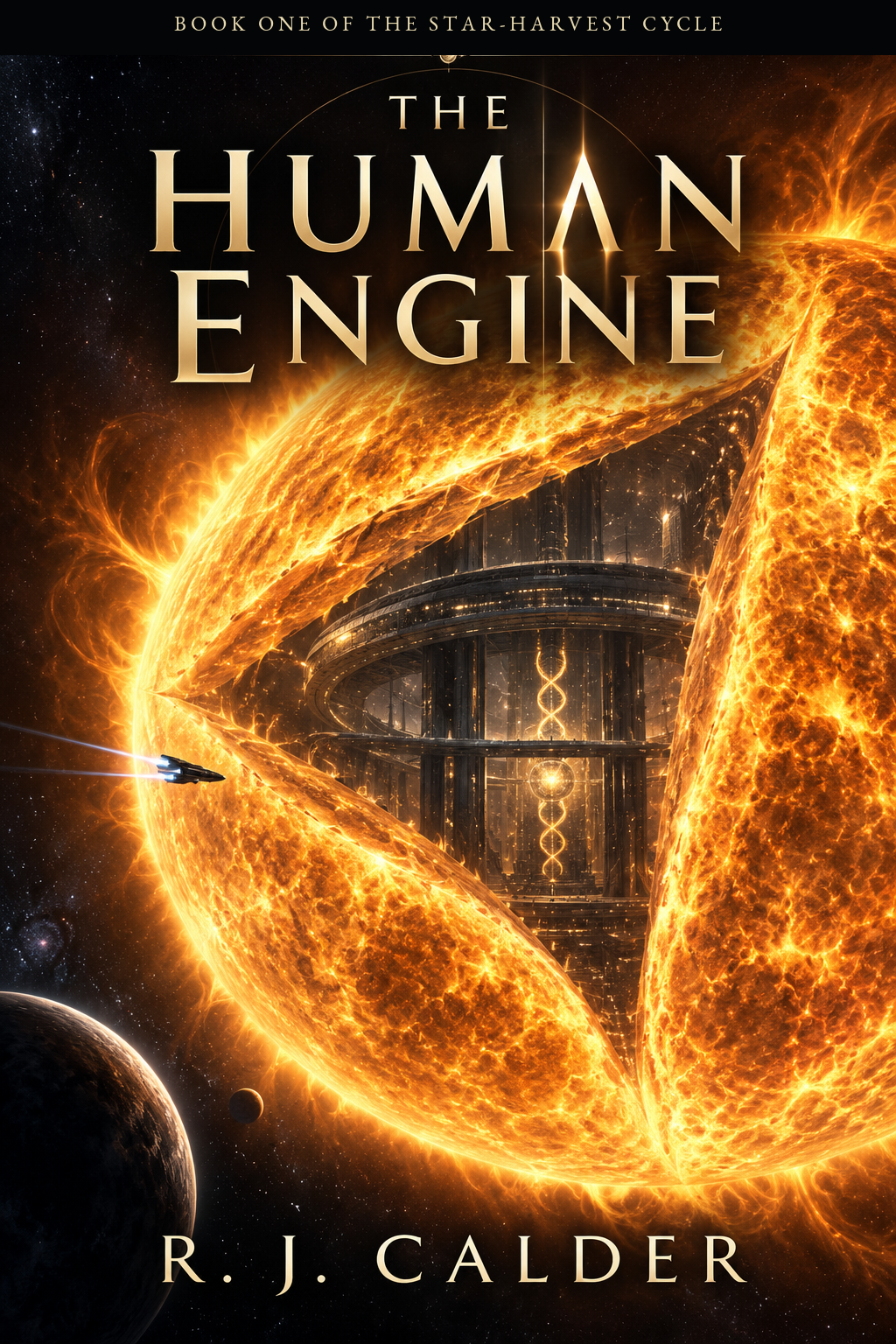
Khepri has fed forty-seven systems for generations. Its extraction rings manufacture the Veyr that makes interstellar civilisation possible, and everyone knows the rules: take only what the star can safely surrender.
Then Khepri opens.
Deep beneath the stellar plasma, physicist Talia Quill finds a structure older than humanity and responsive to human biology. As the discovery destabilises the mine, transit networks and the politics of genetic optimisation, Talia is forced into an alliance with Iven Rook—a Natural whose unmodified biology was once treated as strategic property—and with a generation engineered to be calmer, healthier and more predictable than either of them.
The deeper they go, the worse the question becomes. Humanity did not merely discover the road between the stars. Something built the conditions that made humans compatible with it. And centuries of optimisation may have been narrowing the very variation the network was designed to preserve.
Saving Khepri will require destroying the mine that billions depend on. Preserving the system may mean continuing an industry built on biological exploitation and stellar damage. The choice is not between good and evil. It is between costs that civilisation has hidden—and costs it can no longer avoid.